
A heel pain exercise plan that adapts every week
 Exercises reviewed by Dr. Carla Shayman, PT, DPT, OCS, doctor of physical therapy
Walkito builds your heel pain exercise plan one week at a time, around goals you can measure. Each morning it adjusts the day to how your foot feels. A short test every 14 days shows what is changing. The plan has no fixed length: when you reach a goal, the next one takes its place.
Heel pain can change from one morning to the next, and a fixed list of exercises can’t tell a good morning from a bad one. So the plan listens to your check-ins and your test results, and changes with them.
How does Walkito build my plan?
Walkito builds your plan in five steps. Each one has its own section below.
- You say what you are working toward, and Walkito sets up to three measured goals, with pain first if something hurts.
- You pick 3, 5 or 7 days a week and sessions of 3, 5 or 10 minutes. Walkito plans one week at a time.
- Each morning, a quick check-in adjusts that day’s session.
- Every 14 days, a test of about 4 minutes measures your progress. After your first goal, it comes every 28 days.
- When you reach a goal, it drops to a lower dose so you keep it, and the next goal starts.
What goals does Walkito work toward?
Walkito works toward five goals, and each one is a number you can test, not a feeling.
| Goal | Target | How it is measured |
|---|---|---|
| Pain-free mornings | Morning pain at or under 1/10 for 14 days in a row | Your morning check-in |
| Arch hold | 60 seconds | The test |
| Calf raises | 25 single-leg calf raises | The test |
| Balance | 30 seconds on one leg | The test |
| Left/right difference | Under 10% between your two sides | Worked out from your calf raises |
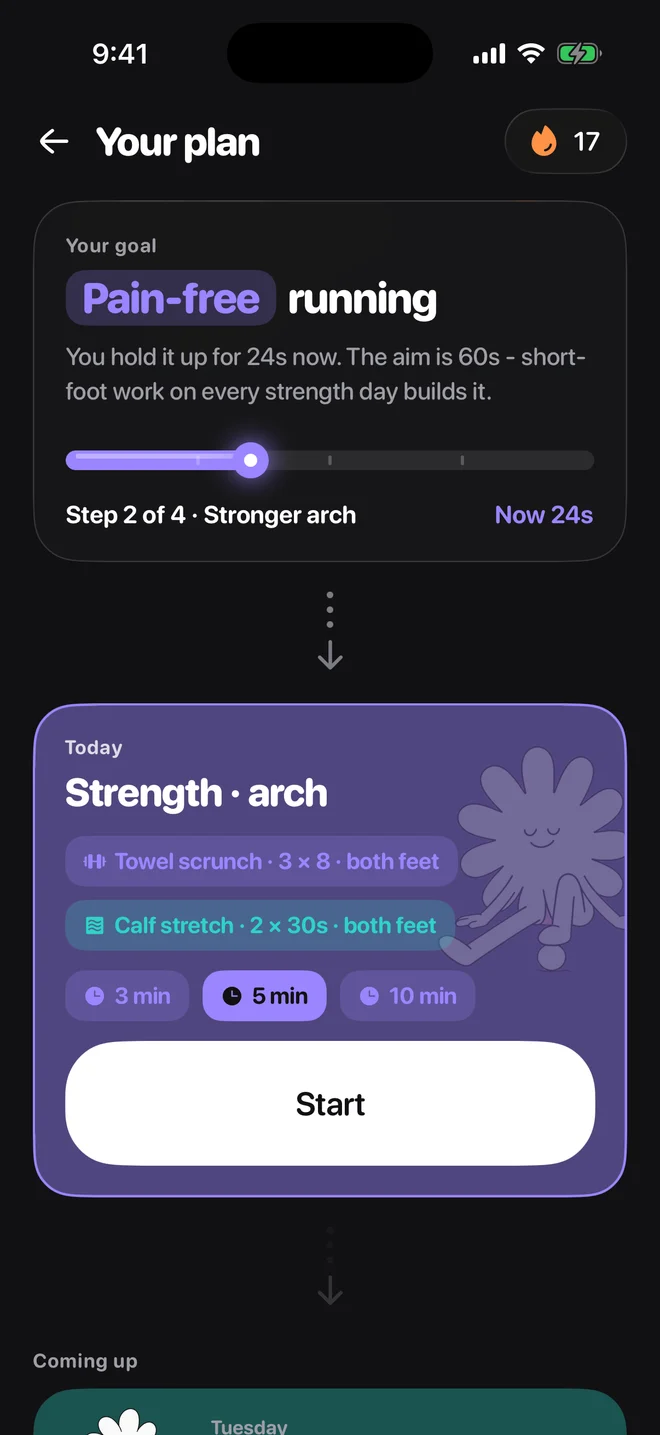
Setup asks what you are working toward, such as running without pain, stronger legs or steadier ankles. Walkito turns your answer into measured goals, in an order that suits it. You start with at most three. If something hurts, pain-free mornings always comes first.
Each week, one goal is the focus, usually the one furthest from its target. Once your morning pain has come down a good way, the focus can move on to a strength goal while the pain keeps settling.
The arch goal is meant for flexible flat feet, where the arch comes back when the foot is off the ground. Walkito doesn’t check which kind you have. If your arch stays flat even off the ground, leave the arch goal aside and see a clinician. Training can’t change a foot whose shape is structural.
How many days a week, and how long are the sessions?
You choose 3, 5 or 7 training days a week and sessions of 3, 5 or 10 minutes. The default is 5 minutes, and you can change it on any day. Each session has 2 to 4 exercises. The exercise for your focus goal comes first and is never cut, not even in a 3-minute session. The others fill the time around it.
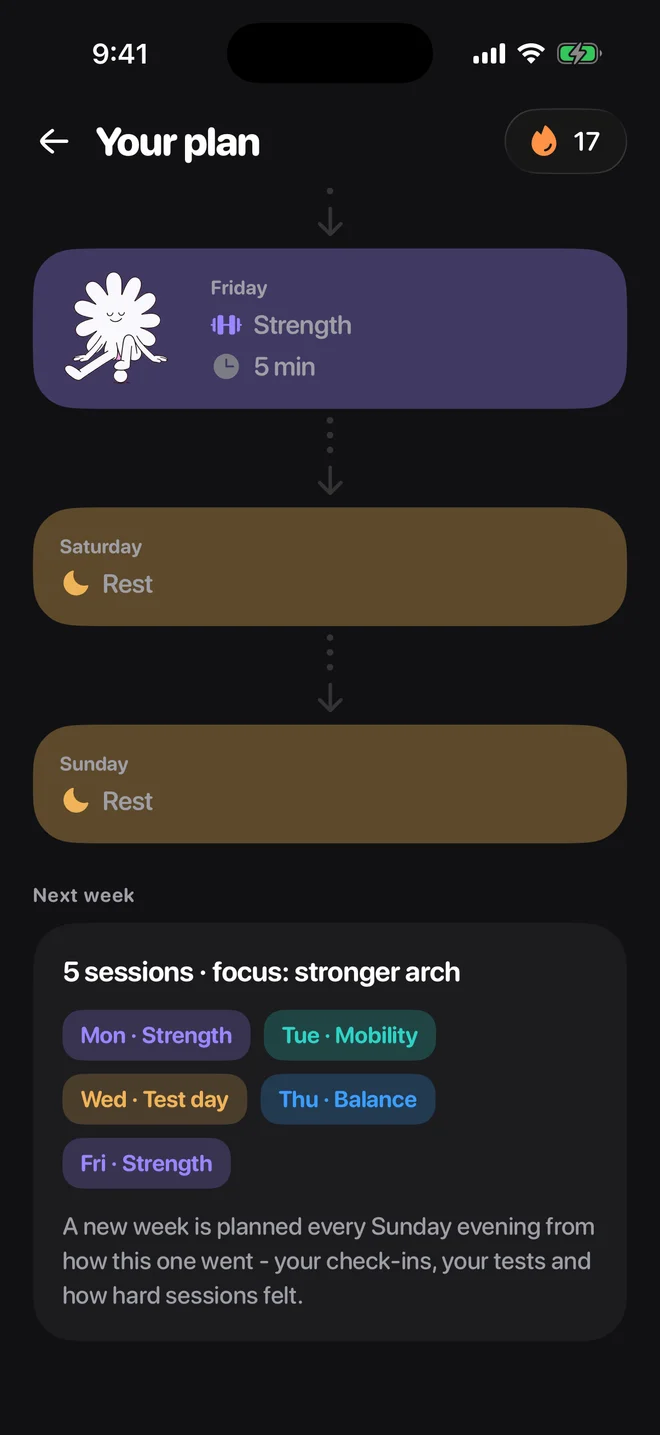
Strength days never fall back to back. With five or seven days, mobility, balance and recovery sessions sit between them. The days without a session are planned rest, and planned rest never breaks your streak.
Walkito builds each new week from how the last one went: your morning pain, and whether sessions felt easy or hard.
What equipment do I need?
You can start the plan with no equipment at all. During setup, Walkito asks what you have at home: a step or stairs, a resistance band, a towel, a pillow or a massage ball. Exercises that need something you don’t have are left out of your plan, and the week is built from the rest. You can pick as many items as you have, or none of them.
Does the plan get harder over time?
The plan gets harder slowly, one level at a time, and only when your foot is ready. Exercises sit on chains, such as calf, arch, balance and hip, from level 1 to level 5.
The chain for your focus goal moves up one level after the last two sessions with that exercise felt easy, and only if your morning pain did not rise that week. A hard session, or a week when morning pain went up, steps it back a level.
The first week settles you in. It uses nothing above level 2 and nothing that loads the plantar fascia, the band of tissue under your foot that runs from the heel to the toes. Loaded work, like the towel heel raise in the heel pain guide, comes later. While pain is your focus goal, calf work on strength days stays at level 1 or 2.
What happens on a bad morning?
On a bad morning, Walkito makes that day’s session lighter. The week says what each day is for. Your morning check-in decides how much of it your foot can take today:
- A high-pain morning (7/10 or more) turns the day into about three minutes of seated work that keeps load off the plantar fascia.
- A morning well above your recent average steps each exercise back a level.
- A big day on your feet yesterday, well above your usual step count, turns a strength session into a lighter recovery one.
- A short night’s sleep steps the session back a level.
- Pain of 6/10 or more during a session ends it, and the next two sessions step back.
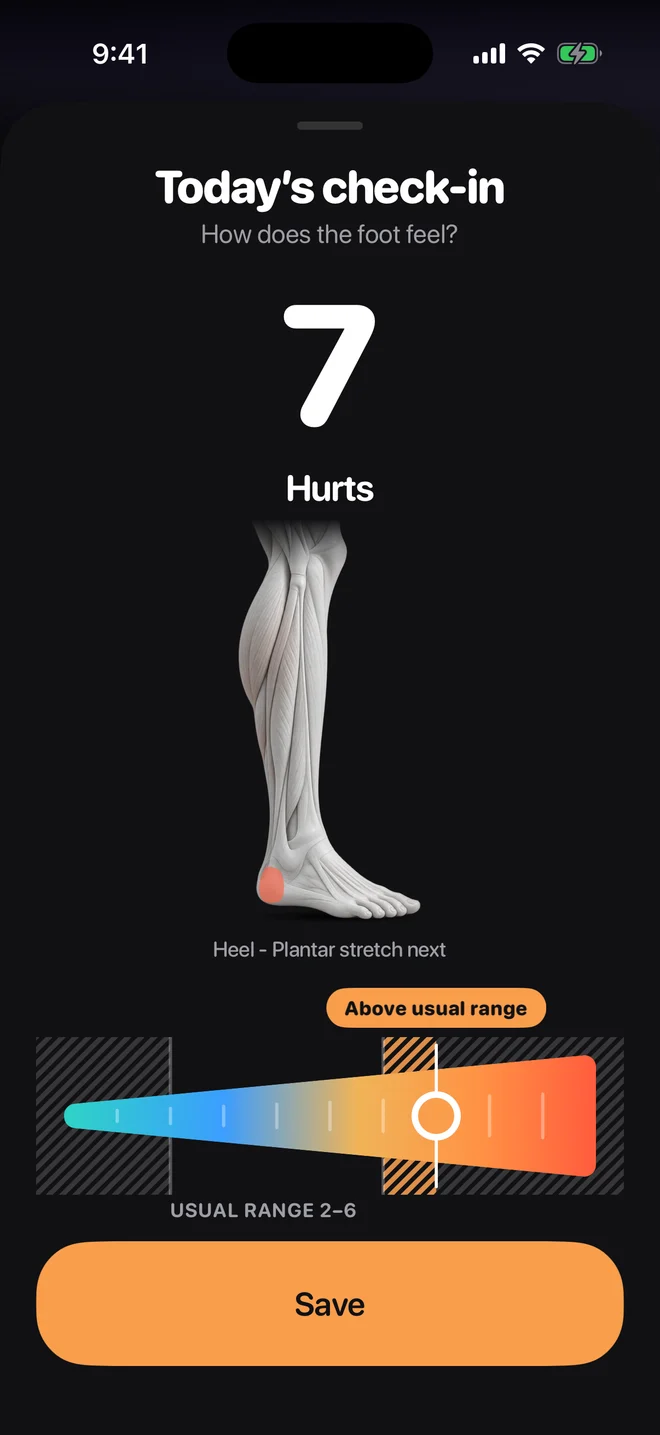
Steps and sleep come from Apple Health, if you allow it. That data stays on your phone.
A good morning never speeds the plan up. A day only steps back, then returns to normal. Progress happens from week to week, not on one lucky morning.
How often does Walkito test my progress?
Walkito tests your progress every 14 days until you reach your first goal, then every 28 days. Each test has 3 parts and takes about 4 minutes:
- calf raises on each leg, as many as you can do
- an arch hold
- balance on one leg
The difference between your left and right side is worked out from the calf raises, so there is no fourth test. A goal counts as reached on these numbers, or on your morning pain log for the pain goal. A streak of sessions never counts on its own.
What happens when I reach a goal?
When you reach a goal, it moves to maintaining, and the next goal takes its place. A maintained goal keeps a spot in your plan at a lower dose: one level down, on some strength days. That way you keep what you built. The plan has no last week and no finish screen. It changes what it works on instead of ending.
Heel pain can come back. Keeping the work that helped, at a lower dose, seemed better to the Walkito team than dropping it the week it stops hurting. That is a design choice, not a research finding.
What is the plan based on?
The plan is based on the exercises and research in the Walkito guides. The exercises and their starting doses are in plantar fasciitis exercises and stretches and flat feet exercises. The trials and the 2023 clinical guideline behind them are on the evidence page. It explains why strength work comes with stretching, and how long arch work took to show in the research. Practical questions are answered in the FAQ.
Starting the plan
You don’t have to work out the order, the doses or when to move up. Walkito does that one week at a time, and the test every 14 days shows you what is changing.
Updated
Walkito is an exercise program. It does not diagnose and does not treat. If pain is sharp, getting worse, or stopping you sleeping, see a clinician.
Start with a 3-minute session.