 WalkitoGet the app
Heel pain in the morning: why it happens and what to do before your first step
Your first steps out of bed are the worst part of the day. That sharp pull at the heel, before you have even stood up straight, is the pattern most people describe when they look up heel pain. The most common cause is plantar fasciitis, but it is not the only one, and the morning is the most useful moment to do something about it.
The plantar fasciitis exercises page covers the full exercise list, the evidence behind each one, and the guideline grades. This page goes deeper on the morning itself: why that first step hurts, what other conditions share the same pattern, what to do before your foot hits the floor, and how tracking your morning pain tells you whether things are getting better.
Why is heel pain worse in the morning?
The plantar fascia, the thick band of tissue that runs from your heel bone to your toes, stiffens while you sleep. Your foot usually points downward at rest, which lets the fascia shorten. When you stand up and flatten the foot under your full weight, that shortened tissue stretches suddenly. The result is a sharp pull at the inside of the heel.
The 2023 heel pain guideline describes this as pain "most noticeable with weight bearing first thing in the morning or after a period of rest." The same pattern happens after you sit for a while and then stand, for the same reason: the tissue shortens at rest, then loads abruptly.
This is not new damage happening each morning. The tissue is stiff, not tearing. Once you have taken a few steps and the fascia warms up, the pain usually eases. That warm-up effect is one of the things that separates plantar fasciitis from some of the other causes below.
What else causes heel pain in the morning?
Plantar fasciitis is the most common cause of morning heel pain, but it is not the only one. The location and behavior of the pain help tell them apart.
Achilles tendonitis. Pain at the back of the heel or in the tendon above it, not under the foot. The Achilles tendon stiffens overnight just as the plantar fascia does, so first-step stiffness is common. It usually improves with walking and then worsens again with prolonged activity. If your pain is at the back of the heel rather than under it, see Achilles tendonitis exercises.
Heel fat pad thinning. The fat pad under your heel bone acts as a cushion. When it thins or shifts, the bone takes more impact directly.
A 2022 scoping review noted that fat pad pain tends to be a deep ache in the center of the heel, feels worse on hard surfaces and with barefoot walking, and can be difficult to tell apart from plantar fasciitis without imaging (Chang and colleagues, 2022). The key difference: plantar fasciitis pain is usually sharpest at the inside front of the heel, while fat pad pain sits right under the center.
Calcaneal stress fracture. Pain that comes on gradually, usually after a jump in activity. Unlike plantar fasciitis, stress fracture pain tends to build with activity instead of easing once you warm up, and it can hurt at rest or at night. If squeezing the sides of the heel reproduces the pain, see a clinician before exercising the foot. Heel pain from running covers how sudden load changes affect the heel.
Inflammatory arthritis (a red flag). When both heels hurt in the morning, the stiffness lasts more than 30 minutes, and other joints are also stiff or swollen, the pattern moves away from plantar fasciitis and toward something a clinician should check. Conditions like psoriatic arthritis or ankylosing spondylitis can cause pain where tendons attach to bone, including the heel.
In a cohort of 174 people with plantar fasciitis followed for a mean of 9.7 years, bilateral heel pain was a significant predictor of worse long-term prognosis, and the authors noted that some unrecognized systemic inflammatory disease could partly explain that finding (Hansen and colleagues, 2018). If both heels hurt and other joints are involved, see a clinician first.
What can you do before your first step?
The most useful thing you can do for morning heel pain happens before your foot touches the floor. The 2023 heel pain guideline gives plantar fascia and calf stretching its top grade, A, and the morning is the single most repeated context in which it recommends stretching.
Sit on the edge of the bed. Cross one ankle over the opposite knee and pull the toes back gently with one hand until you feel a stretch along the arch. Hold for about 10 seconds, then release. Do that 10 times on each foot. This loads the fascia slowly, in a controlled way, before you ask it to take your full weight.
Follow with a calf stretch. Stand near the bed or a wall, one foot behind the other, back heel on the floor, and lean forward until you feel the stretch in the upper calf. Hold for 30 seconds each side.
Tight calves pull on the heel through the Achilles tendon, and reduced ankle flexibility is one of the strongest independent risk factors for plantar fasciitis: in a matched case-control study of 50 cases and 100 controls, it had the highest odds ratio of any measured factor (Riddle and colleagues, 2003).
Then put on supportive shoes or firm-soled slippers before walking to the kitchen. Barefoot on a hard floor is the worst combination for a stiff fascia. These morning stretches are the starting point. The longer-term plan adds strength work: calf raises for plantar fasciitis are the exercise with the most direct trial evidence behind them.
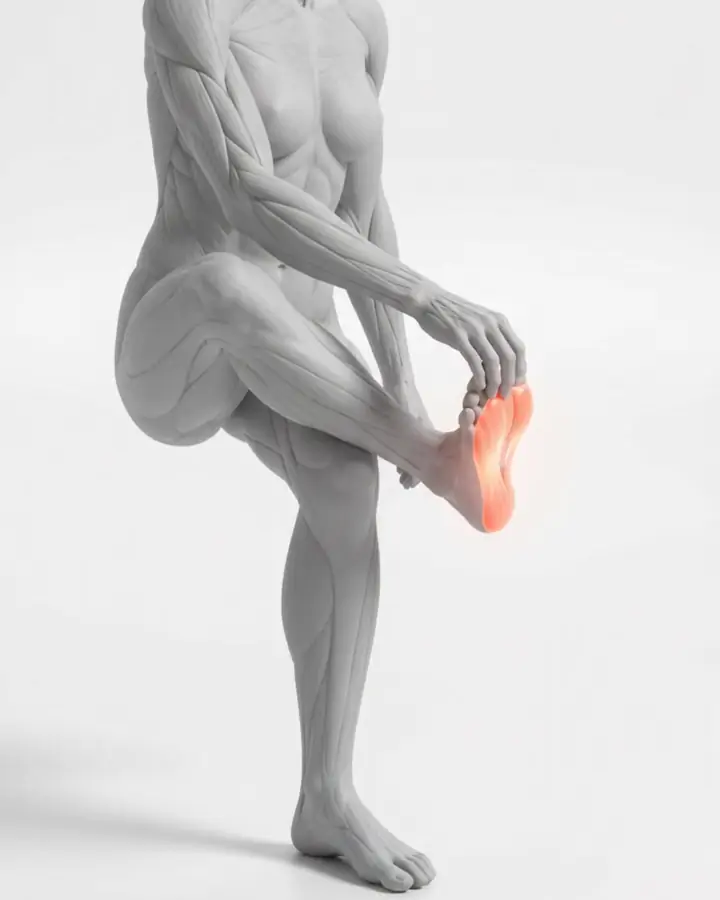
Plantar fascia stretch (seated, before standing)
Sit on the bed. Cross one ankle over the other knee. Pull the toes back gently until you feel a stretch along the arch. Hold, then release.
Evidence: Strong. The 2023 guideline grades plantar fascia and calf stretching A, its top grade.
Pain reaches 6/10
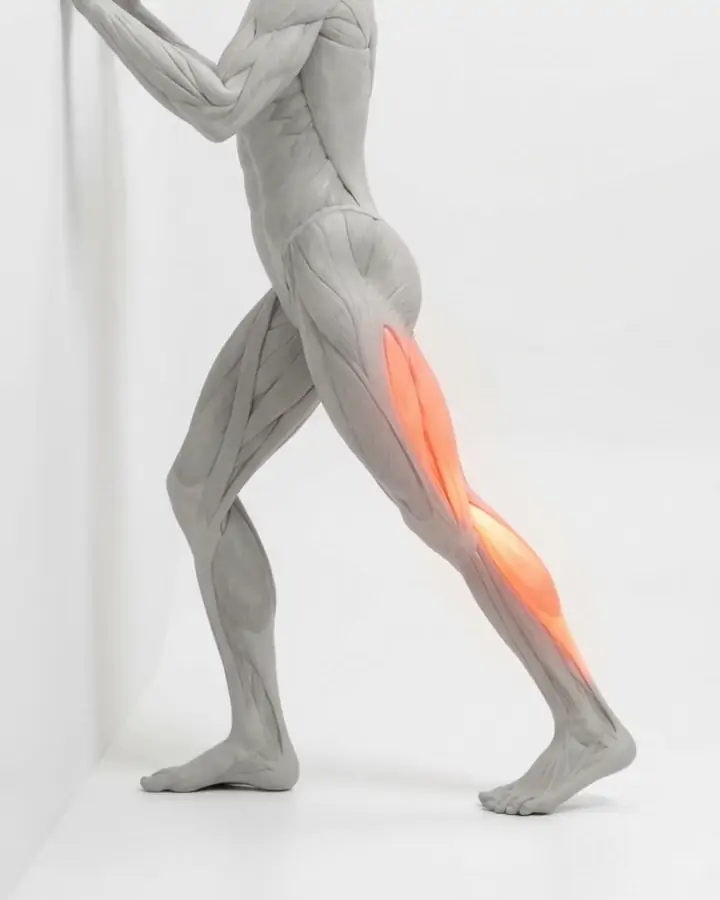
Calf stretch (straight knee)
Hands on a wall. Back leg straight, heel down, hips forward. Hold until you feel the stretch in the upper calf.
Evidence: Strong. Same guideline grade A. Targets the gastrocnemius, the bigger outer calf muscle.
Pain reaches 6/10
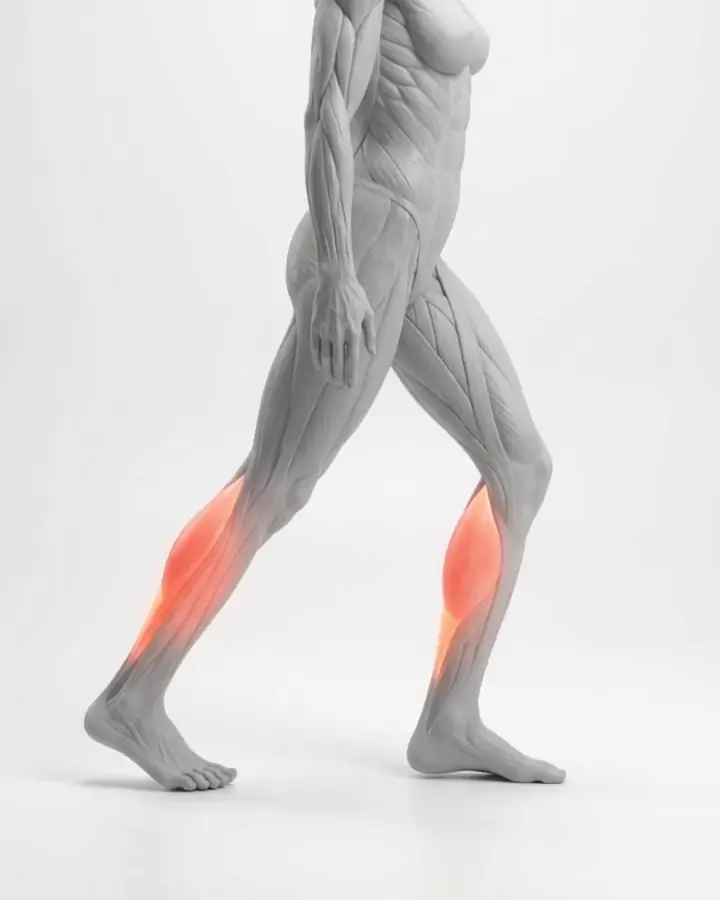
Soleus stretch (bent knee)
Same position as the calf stretch, then bend the back knee until you feel the stretch lower, near the heel. The soleus, the deeper calf muscle, only releases with the knee bent.
Evidence: Strong. Same guideline grade A. Targets the soleus, the deeper calf muscle.
Pain reaches 6/10
Do night splints help morning heel pain?
Night splints hold the foot at a right angle while you sleep, so the plantar fascia and calf stay gently lengthened instead of shortening overnight. The idea is simple: if morning pain comes from the fascia stiffening at rest, keeping it stretched should take some of that first-step shock away.
The 2023 heel pain guideline gives night splints a grade of A for people whose first steps in the morning keep hurting despite stretching and other conservative care. The recommended duration is 1 to 3 months. Most night splints are a rigid or semi-rigid boot that props the foot up.
Some people find them uncomfortable to sleep in, and the guideline does not suggest them as a first step for everyone. They are for the group that has already been stretching and still wakes up in pain.
Night splints are something to talk over with a clinician. They are not an exercise, and no app can provide them. But they are worth knowing about because they have one of the strongest evidence grades in the guideline, specifically for the problem this page is about: first-step pain that will not settle.
Should you wear shoes at home if your heels hurt?
Walking barefoot on a hard floor puts the plantar fascia under its maximum stretch with no cushion underneath. For someone whose fascia is already irritated, this is the worst combination, and it usually happens right after the morning stretch when the tissue is still warming up.
Supportive shoes or firm-soled slippers at home keep the arch slightly lifted and cushion the heel. The 2023 guideline recommends footwear education as part of the overall approach, and reduced ankle flexibility, meaning how far the foot bends up toward the shin, is one of the strongest risk factors for plantar fasciitis. A shoe with a small heel-to-toe drop helps compensate for a tight calf.
This does not need to be a special shoe. Any sneaker or house shoe with a firm sole and some arch support is better than bare feet on tile or hardwood. If your pain is worse at home than outside, this is often why. Standing all day on hard surfaces causes a related problem: feet hurt from standing all day covers the exercises and footwear for that.
How does morning pain show whether things are getting better?
Morning pain is the clearest day-to-day signal of how a foot is doing. A run might feel fine but leave the fascia overloaded, and you will not know until the next morning. A long shift on your feet may feel tolerable, but the next morning tells you whether it was too much. The pattern is simple: if your first steps the next morning are worse than usual, yesterday asked more of the foot than it could handle.
That is why a daily morning pain score, 0 to 10, is more useful than checking pain during the day. Daytime pain rises and falls with activity, posture, and shoes. Morning pain measures the same thing, in the same way, at roughly the same time every day. When the number drops over weeks, the foot is gaining ground. When it spikes, something in the past day or two pushed too far.
Walkito asks for a morning pain score before every session. If the score is 7 or higher, the day becomes a gentle session: only seated, low-load exercises that do not stress the fascia, capped at 3 minutes. If the score is 3 or more points above the 7-day average, the app steps each exercise down one level. If yesterday had more hours on your feet than usual, a strength session converts to a lighter recovery one.
The goal is morning pain at or under 1 out of 10 for 14 days in a row. That trend, not any single reading, is what tells you the foot is ready for the next stage.
Questions people ask
Why does my heel hurt only in the morning?
The plantar fascia, the thick band of tissue under your foot, stiffens and shortens while you sleep. Your first steps stretch it under your full weight. The 2023 heel pain guideline describes this as pain "most noticeable with weight bearing first thing in the morning or after a period of rest." Once you walk for a few minutes the tissue warms up and the pain usually eases.
Should I stretch before getting out of bed?
Yes. The 2023 heel pain guideline gives plantar fascia and calf stretching its top grade, A, and the morning is the context it most often names. Sit on the edge of the bed, cross one ankle over the other knee, and pull the toes back gently for about 10 seconds, 10 times each foot. This loads the fascia slowly before you ask it to take your full weight.
Is morning heel pain always plantar fasciitis?
Not always. Achilles tendonitis (pain at the back of the heel), heel fat pad thinning (deep central ache, worse barefoot on hard surfaces), calcaneal stress fracture (builds with activity, may hurt at rest), and inflammatory arthritis (both heels, prolonged stiffness, other joints involved) can all cause morning pain. Location and behavior help tell them apart, but a clinician makes the call.
Do night splints work for morning heel pain?
The 2023 heel pain guideline gives night splints a grade of A, its top grade, for people whose first steps keep hurting despite stretching. Night splints hold the foot at a right angle overnight so the fascia stays gently lengthened instead of shortening. The recommended duration is 1 to 3 months. They are worth discussing with a clinician if stretching alone is not enough.
Why does my heel hurt again after sitting?
The same reason it hurts in the morning. The plantar fascia shortens and stiffens when the foot is unloaded, whether you are asleep or just sitting at a desk. When you stand up, it stretches suddenly. The guideline calls this "first-step pain after a period of rest." Doing a brief fascia stretch before standing can help.
When should I see a doctor about morning heel pain?
See a clinician if both heels hurt and morning stiffness lasts more than 30 minutes, if the pain followed an injury, if it is getting worse week over week, if it keeps you up at night, if squeezing the sides of the heel reproduces it, or if it comes with numbness, swelling or warmth. These patterns can point to something besides plantar fasciitis.
How long does first-step pain take to get better?
A 2020 review reports that about 90 percent of people with plantar fasciitis improve with non-surgical care, often within several months (Latt and colleagues, 2020). In a longer follow-up of 174 patients, about half were still symptomatic at 5 years, though most had only minor pain by that point (Hansen and colleagues, 2018). No exercise program can promise a timeline. How long plantar fasciitis lasts covers the evidence in more detail.
See a clinician first if
- both heels hurt and morning stiffness lasts more than 30 minutes, especially if other joints are stiff or swollen
- the pain followed an injury or a fall, which can indicate a plantar fascia tear
- you cannot put weight on the foot, or you are limping
- squeezing the sides of the heel reproduces the pain, which can point toward a stress fracture
- it comes with numbness, tingling or burning, which can point to nerve entrapment
- the heel is red, warm to the touch, or you have a fever
- it wakes you at night or is present at rest, not just on first steps
- it has not improved after several weeks of daily stretching and a lighter load
- you have diabetes, reduced feeling in your feet or poor circulation
Doing it as a plan
You do not have to remember the stretches, the doses or when to move to something harder. Walkito builds a plan one week at a time around one goal. For heel pain, the first goal is a better morning: pain at or under 1 out of 10 for 14 days in a row. Every morning you log your pain before your first step, and the day's session adjusts to that score.
You pick 3, 5 or 7 days a week and sessions of 3, 5 or 10 minutes. Every 14 days (then every 28 once the morning goal is met), a short test checks calf endurance, arch hold and balance, so you can see what is changing.
Walkito is an exercise program. It does not diagnose and is not a substitute for a clinician. If morning pain is sharp, getting worse, or in both heels with other joints involved, see a clinician first.
Updated
Walkito is an exercise program. It does not diagnose and does not treat. If pain is sharp, getting worse, or stopping you sleeping, see a clinician.
Start with 3 minutes a day.