 WalkitoGet the app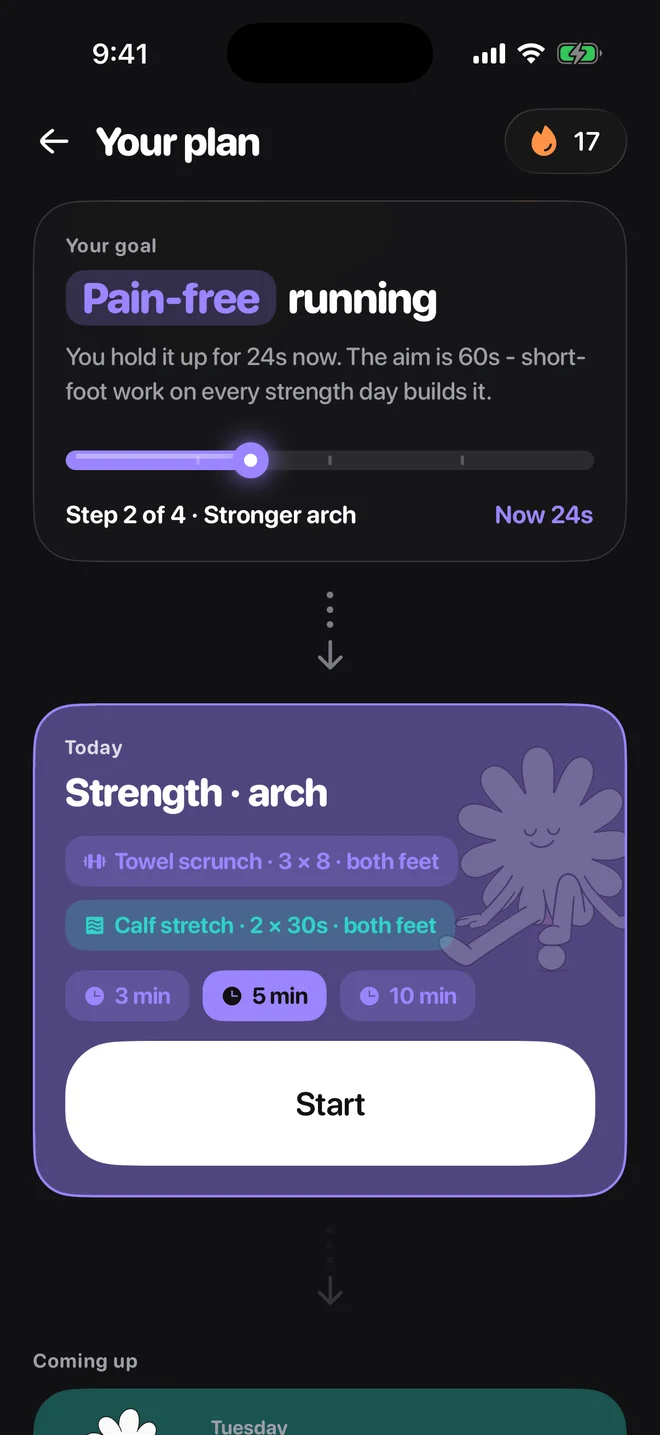
Is heel pain after running plantar fasciitis?
Heel pain on the first steps in the morning, or after you sit for a while, is the pattern most often linked to plantar fasciitis. That is pain from the plantar fascia, the band of tissue under the foot. The 2023 clinical guideline for heel pain calls plantar fasciitis the most commonly recognized cause of heel pain under the foot.
Plantar fasciitis is not the only cause. The same guideline names stress fractures among the other causes of heel pain, and only a clinician can say what is behind yours.
Should you rest or keep running with heel pain?
If heel pain flares when you run, change the load instead of stopping everything. The 2023 guideline recommends learning how to adjust the load on your feet at work, in sport and in daily life. That advice is graded E, which means it rests on theory, not trials. So there is no trial-tested rule for how much to cut back.
For example, changing the load can mean shorter runs, fewer runs in a week or easier ones. Keep the plantar fascia and calf stretches every day, and cut back whatever makes the heel worse. On a bad morning, keep the stretches and drop the heel raises for the day.
What does the next morning tell you after a run?
The morning after a run tells you whether that run was more than your heel could take. Morning pain is the clearest sign of how your foot coped with the day before. If your first steps are clearly worse after a run, make the next one lighter.
Walkito asks about your morning pain every day for the same reason. You log it in one tap on a scale from 0 to 10, and that score decides how much today’s session asks of you. The first goal for heel pain is a better morning: pain at 1/10 or less for 14 days in a row.
Which exercises help heel pain from running?
Stretching and calf strength work are the exercises with the most evidence for plantar fasciitis. The 2023 guideline gives plantar fascia and calf stretching its top grade, A, and resistance and strength training a B.
In a trial of 48 people, all wearing shoe inserts, slow heavy heel raises with a towel under the toes eased pain and improved daily function faster than stretching alone. By twelve months, both groups were even. Strength work brought the improvement forward. It did not make it bigger. The guideline supports doing both.
The doses, how often to do each one and what each should feel like are in the plantar fasciitis exercises guide. The study-by-study reasoning is on the evidence page.
How does Walkito adapt to yesterday’s run?
Walkito adapts each session to yesterday’s load and this morning’s heel, so a hard day lowers the load without stopping the plan. If you connect Apple Health, Walkito reads your steps and sleep. If your phone or watch counts your run’s steps, a long run adds to that day’s total. The Health data stays on your phone. Each morning, the first row below that matches sets today’s session.
| This morning | What today’s session does |
|---|---|
| Morning pain of 7/10 or more | A 3-minute session of seated work, with nothing that loads the plantar fascia |
| Morning pain 3 or more points above your average for the last 7 mornings | Each exercise steps down to an easier level |
| Yesterday’s steps more than 1.4 times your 28-day average, on a strength day | The strength session becomes a lighter recovery session |
| Less than 6 hours of sleep | Each exercise steps down to an easier level |
During a session, pain of 6/10 or more ends it, and the next two sessions step down a level. A bad day lowers the load. It doesn’t stop the plan.
Questions runners ask
Can I keep running with plantar fasciitis?
You don’t have to stop everything. Change the load instead. The 2023 heel pain guideline recommends learning to adjust the load on your feet, graded E, which means it comes from theory, not trials. Run shorter, less often or easier, and keep stretching every day. If running hurts sharply or the pain keeps getting worse, see a clinician.
Why does my heel hurt the morning after a run?
Heel pain on the first steps after sleep is the pattern most often linked to plantar fasciitis. The usual explanation is that the tissue under the foot stiffens at rest, then gets loaded suddenly by those first steps. If your first steps are clearly worse the morning after a run, that run was more than the heel could take.
Could heel pain from running be a stress fracture?
Heel pain from running can be a stress fracture. Pain that builds during runs after you added mileage, or pain when you squeeze the sides of the heel, can both be signs of one. The 2023 guideline names stress fractures among the other causes of heel pain. Walkito can’t tell them apart, so stop and see a clinician first.
When should a runner see a clinician about heel pain?
A runner should see a clinician before running on if the pain builds during runs after adding mileage, or if squeezing the sides of the heel hurts. Both can be signs of a stress fracture. Sharp pain when you run, or pain that gets worse week after week, needs a clinician too.
See a clinician first if
- the pain followed an injury or a fall
- you cannot put weight on the foot, or you are limping
- it comes with numbness, tingling, burning, swelling or warmth
- the heel is red, or you have a fever or feel unwell
- it wakes you at night
- it is sharp, or getting worse despite easing the load
- squeezing the sides of the heel hurts, or the pain builds during runs after you increased your mileage; both can be signs of a stress fracture
- you have diabetes, reduced feeling in your feet or poor circulation
- both heels hurt and other joints are swollen or stiff
- it has not improved after several weeks of exercise and a lighter load
- one arch has flattened suddenly as an adult
Doing it as a plan
You don’t have to work out the order, the doses or when to move on. Walkito builds a plan one week at a time around one goal you can measure. For heel pain, the first goal is morning pain at 1/10 or less for 14 days in a row. The others are a 60-second arch hold, 25 single-leg calf raises, 30 seconds of single-leg balance, and left and right within 10% of each other. A goal you reach moves to maintaining at a lower dose, and the next one takes its place.
You pick 3, 5 or 7 days a week and sessions of 3, 5 or 10 minutes. Every 14 days (then every 28 once your first goal is reached), 3 tests in about 4 minutes check calf raises to failure, an arch hold and single-leg balance on both sides. Progress is measured, not guessed from how the week felt. How the plan works.
Walkito is an exercise program. It does not diagnose and does not treat. If pain is sharp, getting worse, or stopping you sleeping, see a clinician.
Start with 3 minutes a day.